
jazz Music – issue #4

Jazz is a music genre that originated in the African-American communities of New Orleans. Since the 1920s Jazz Age, it has been a major form of musical expression in traditional and popular music. It was developed partially from ragtime and blues. often characterized by syncopated rhythms and polyphonic ensemble playing. incorporating varying degrees of improvisation, often deliberate deviations of pitch, and the use of original timbres. As jazz spread around the world, it drew indigenous musical cultures, which gave rise to different styles. In the 1930s, arranged dance-oriented swing big bands was the prominent styles. Bebop emerged in the 1940s, representing a shift from danceable popular music. Now a more challenging music emerged which was played at faster tempos and used more chord-based improvisation. Cool jazz developed near the end of the 1940s, introducing calmer, smoother sounds and long, linear melodic lines. Free jazz is a style of avant-garde jazz . This experimental style of jazz improvisation developed in the late 1950s and early 1960s. Jazz fusion appeared in the late 1960s and early 1970s. a Fusion combining jazz improvisation with rock music’s rhythms, electric instruments, and highly amplified stage sound. In the early 1980s, a commercial form of jazz fusion called smooth jazz became successful, garnering significant radio airplay. For almost all of its history it has employed both creative approaches in varying degrees and endless permutations. despite the all these diverse styles, jazz is distinguishable as something separate from all other forms of musical expression. Especially from classical music. The jazz performer is primarily or wholly a creative, improvising composer. On the other hand in classical music the performer typically expresses and interprets someone else’s composition.
Join the Conversation!!!
we will Feature Up to 3 Albums from Artists representative of a range of the Many sub-genres. We Hope to encourage Listeners of all tastes and passions. So Get your Headphones on and Consider discussing the musical Offering and sharing your views with like-minded peers.
In Issue #4, we feature herbie hancock
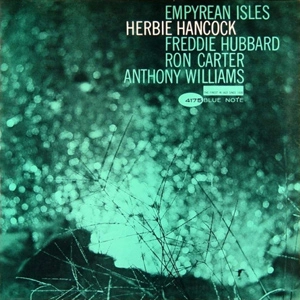
Empyrean Isles is the fourth studio album by American jazz pianist Herbie Hancock, released on Blue Note Records in November 1964, it is considered a landmark of 1960s post-bop and modal jazz, a style of jazz that uses musical modes as a harmonic framework for improvisation, rather than relying on traditional, complex chord progressions. The album features Hancock alongside trumpeter Freddie Hubbard, bassist Ron Carter, and drummer Tony Williams. The album consists of four original Hancock compositions that range from catchy soul-jazz to experimental avant-garde: “One Finger Snap”: A fast-paced, high-energy track that pushes the quartet into blistering improvisations. “Oliloqui Valley”: A mystical, modal piece built around a searching bass riff by Ron Carter. “Cantaloupe Island”: One of Hancock’s most famous and enduring tunes, known for its funky piano vamp. “The Egg”: An ambitious 14-minute experimental track that features free-form improvisation and unconventional techniques, such as Ron Carter playing the bass with a bow. It is often paired with its 1965 successor, Maiden Voyage, as the pinnacle of Hancock’s early acoustic period.and more.
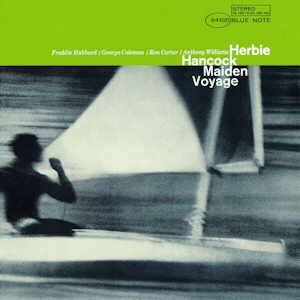
Maiden Voyage is one of the most creative of the pianist and composer. in March 1965 the pianist went into the studio with Ron Carter, Tony Williams, and trumpeter Freddie Hubbard who was joined in the frontline by tenor saxophonist George Coleman to record Maiden Voyage. By the time he recorded this, Hancock had been in the Miles Davis Quintet for several years. It’s a classic that’s justifiably revered for its compositions and its solos, and also, perhaps most importantly, the rich and delicate interactions that run throughout. It is a concept album aimed at creating an oceanic atmosphere. As such, many of the track titles refer to marine biology or the sea, and the musicians develop the concept through their use of space allowing a freedom for the music to be opened up and thoroughly explored for fresh ideas by the assembled cast. Stephen Thomas Erlewine of AllMusic describes the album as “arguably his finest record of the ’60s, reaching a perfect balance between accessible, lyrical jazz and chance-taking hard bop”.
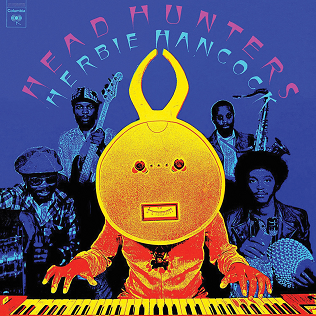
Head Hunters is Hancock’s twelfth studio album released October 26, 1973, on Columbia Records. The album was a commercial and artistic breakthrough for Hancock, and a defining moment in the genre of jazz, crossing over to funk and rock audiences and bringing jazz-funk and jazz fusion to mainstream attention. But it was a sticking point for critics who called the great jazz piano player a pop sell-out. Hancock assembled a new band, the Headhunters. The core Headhunters band on the album included: Bennie Maupin (woodwinds) Paul Jackson (bass guitar, marímbula) Harvey Mason (drums) Bill Summers (percussion). The rhythms are infectious, the solos are electrifying, and the overall groove is undeniable. Tracks like “Watermelon Man” and “Sly” showcase Hancock’s ability to create music that is both complex and accessible. On a song named after funk master Sly Stone himself. “Sly” may not have the cultural cachet of “Chameleon” or “Watermelon Man,” but it is the album’s true synthesis of funk combining and interacting with the distinctive rhythmic groove of jazz. Finally, Head Hunters cools down with “Vein Melter,” a psalm on death written for a friend of Hancock’s who died of a heroin overdose. Each song is like a musical puzzle, with layer upon layer of intricate melodies and harmonies. The Library of Congress added it to the National Recording Registry.
Empyrean Isles
maiden Voyage
Head Hunters

Hancock was born in Chicago, Illinois. He attended Hyde Park High School in Chicago. He began playing the piano at the age of seven, and his talent was recognized early on. Like many jazz pianists, Herbie took classical piano lessons. Considered to be a child prodigy, he played the first movement of Mozart’s Piano Concerto No. 26 at a young people’s concert on February 5, 1952, with the Chicago Symphony Orchestra at the age of 11.
During his teenage years, Herbie Hancock did not have a jazz teacher. He developed his ear and sense of harmony by listening to Hard Bop and the recordings of jazz pianists. Hancock was also influenced by the harmonies and arrangements on records of the vocal group the Hi-Lo’s. In 1960, Hancock heard the jazz pianist Chris Anderson play just once and begged him to accept him as a student. Hancock often mentions Anderson as his harmonic guru. Hancock graduated, in 1960, with degrees in electrical engineering and music. Hancock then moved back to Chicago, and began working with Donald Byrd and Coleman Hawkins. Hancock recorded his first solo album, Takin’ Off, for Blue Note Records in 1962. Takin’ Off caught the attention of Miles Davis, who was at that time assembling a new band. Hancock received considerable attention when, in May 1963, he joined Davis’s Second Great Quintet.
While in Davis’s band, Hancock also found time to record dozens of sessions for the Blue Note label, both under his own name and as a sideman with other musicians. Herbie’s own solo career blossomed on Blue Note, with classic albums including ‘Maiden Voyage’, ‘Empyrean Isles’, and ‘Speak Like a Child’. He composed the score to Michelangelo Antonioni’s 1966 film ‘Blow Up’, which led to a successful career in feature film and television music. After leaving Davis, Herbie put together a new band called The Headhunters and, in 1973, recorded ‘Head Hunters.’ With its crossover hit single “Chameleon,” it became the first jazz album to go platinum. By mid-decade, Herbie was playing for stadium-sized crowds all over the world and had no fewer than four albums in the pop charts at once. In total, Herbie had 11 albums in the pop charts during the 1970s. His ’70s output inspired and provided samples for generations of hip-hop and dance music artists. Herbie also stayed close to his love of acoustic jazz in the ’70s, recording and performing with VSOP (reuniting him with his Miles Davis colleagues), and in duet settings with Chick Corea and Oscar Peterson. In 1983, a new pull to the alternative side led Herbie to a series of collaborations with Bill Laswell.
Herbie won an Oscar in 1986 for scoring the film “‘Round Midnight”, in which he also appeared as an actor. After an adventurous 1994 project for Mercury Records, ‘Dis Is Da Drum’, he moved to the Verve label, forming an all-star band to record 1996’s Grammy-winning ‘The New Standard’. In 1997, an album of duets with Wayne Shorter, ‘1+1’, was released. In 1998, the recording and release of ‘Gershwin’s World’, which included collaborations with the likes of Joni Mitchell, Stevie Wonder, Wayne Shorter and Chick Corea, won three Grammys in 1999, including Best Traditional Jazz Album. ‘possibilities’ released in August 2005, teamed Herbie with many popular artists and earned a Grammy nomination in Best Pop Collaboration . In 2007, Hancock recorded and released ‘River: The Joni Letters’, a tribute to longtime friend and collaborator Joni Mitchell. The album received glowing reviews and garnered three Grammy Awards, including Album of the Year. In 2010 Hancock released the critically-acclaimed CD, ‘Herbie Hancock’s The Imagine Project,’ winner of two 20ll Grammy Awards for Best Pop Collaboration and Best Improvised Jazz Solo. Utilizing the universal language of music to express its central themes of peace and global responsibility.

In February 2016 he was awarded the Grammy Lifetime Achievement Award. Herbie Hancock remains where he has always been: in the forefront of world culture, technology, business and music.
Hancock has cut a zigzagging forward path, shuttling between almost every development in electronic and acoustic jazz and R&B over the last third of the 20th century and into the 21st.
Sound quality is important and the better online Streaming services will offer superior sound quality. As always, We do encourage you to purchase Favoured albums from good online or High street record stores.
Artists in upcoming issues: ornette Coleman, Bill Evans, brad Mehldau…..Keep Listening!! JOIN THE CONVERSATION…jazz Music