Classical Music – issue #3
Classical music generally refers to the art music of the Western world. Classical music is often characterized by formality and complexity in its musical form and harmonic organization. particularly with the use of polyphony, music in which several different tunes are played or sung at the same time. Since the ninth century, it has been primarily a written tradition, spawning a sophisticated notational system.
Rooted in the patronage of churches and royal courts in Europe. early medieval music is chiefly religious, monophonic and vocal. The Baroque period (1580–1750) saw the relative standardization of common-practice tonality. Together with, the increasing importance of musical instruments, which grew into ensembles of considerable size. The common-practice period was a period in which the tonal system was regarded as the only basis for composition. The word tonality is sometimes used as a synonym for “key.”.
In the shorter but pivotal Classical period (1730–1820), composers such as Mozart created widely admired examples of absolute music. including symphonies, string quartets and concertos. Absolute music (sometimes abstract music) is instrumental music not intended to represent or illustrate something else. The ensuing Romantic music (1800–1910) focused instead on programmatic music. the art song, symphonic poem and various piano genres were important vessels. Program music is often written so that the notes themselves convey, to some degree, the meaning of what is portrayed. Thus the thunderstorm in Beethoven’s symphony includes loud timpani strokes to convey the thunder. The shrill piccolo music to depict the shrieking winds. During this time virtuosity was celebrated, immensity was encouraged, while philosophy and nationalism were embedded. all aspects that converged in the operas of Richard Wagner.
By the 20th century, the prominence of popular music greatly increased. Many Classical composers actively avoided past techniques and genres in the lens of modernism. with some abandoning tonality in place of serialism. a serial pattern in music is merely one that repeats over and over within a composition. The term serial music is often used interchangeably with 12-tone music. However, the latter is more properly an example of the former. others found new inspiration in folk melodies or impressionist sentiments.
Trends of the mid-20th century to the present day include New Simplicity, New Complexity, Minimalism, Spectral music. more recently Postmodern music and Postminimalism.
Join the Conversation!!!
we will Feature Significant Compositions from Artists representative of the various classical Periods. We Hope to encourage Listeners of all tastes and passions. So Get your Headphones on and Consider discussing the musical Offering and sharing your views with like-minded peers.
In Issue #3, we feature Ludwig van Beethoven
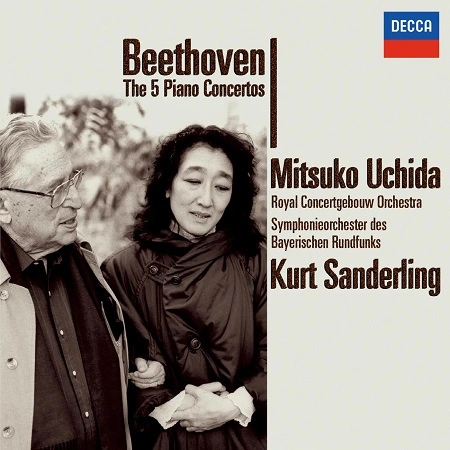
famously known as the “Emperor”, this is his last completed piano concerto. Composed between 1809 and 1811 during the Napoleonic Wars, it is celebrated for its heroic character and grand scale. The concerto follows the standard three-movement structure but features an unconventional opening where the soloist enters immediately with brilliant cadenzas before the orchestra presents the main themes. I. Allegro: A majestic and expansive movement in E-flat major. II. Adagio un poco mosso: A serene and spiritual movement in the remote key of B major. III. Rondo: Allegro ma non troppo: A triumphant and energetic finale in E-flat major that follows the second movement without a break.
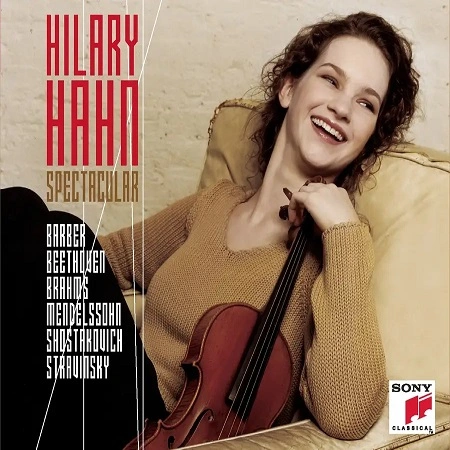
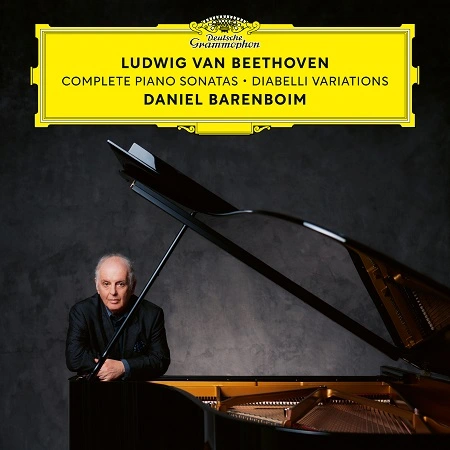
Beethoven wrote 32 piano sonatas between 1795 and 1822.
No. 8 in C Minor, Op. 13 (“Pathétique”): Noted for its tragic and dramatic character, written in 1799. No. 14 in C-sharp Minor, Op. 27, No. 2 (“Moonlight”): One of the most famous pieces in classical music, particularly for its ethereal first movement. Beethoven’s late sonatas were some of his most difficult works and some of today’s most difficult repertoire. No. 29 in B-flat Major, Op. 106 (“Hammerklavier”): Known for its massive scale and extreme difficulty.
Beethoven’s Violin Concerto in D major, Op. 61, Written during a peak creative period in 1806, it remains Beethoven’s only completed concerto for the violin. This concerto is not heroic or dramatic, not even virtuosic in the extreme. It is simple and beautiful. Beethoven eschewed flashy technical feats in favour of simple yet deeply-felt melodies woven into a truly symphonic structure. Before the soloist enters, the first movement begins with a substantial orchestral introduction. A sweeping dialogue between the violins and lower strings concludes the orchestral introduction, dying away as the soloist enters. The slow second movement is the emotional heart of the concerto. A cadenza for the soloist then links the second movement to the finale. The last movement beginning with a spirited hunting tune is a joyful, “folksy” finale that provides a lively contrast to the earlier movements.
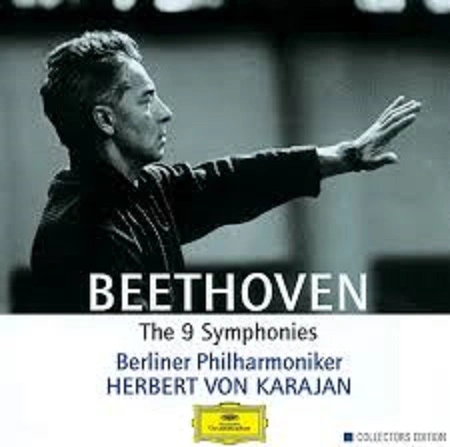
Beethoven’s Symphony No. 3, the “Eroica” (Heroic), is a masterpiece composed around 1803-1804 that dramatically expanded symphonic form, bridging the Classical and Romantic eras with its immense scale, emotional depth, and narrative focus, originally dedicated to Napoleon but later retracted, marking a turning point in Western music history. Its four movements, including the famous funeral march and a triumphant finale, are known for their unprecedented length, complex harmony, and exploration of heroic Themes. Beethoven’s Symphony No. 5 in C minor, Op. 67, is one of the most recognized and influential compositions in Western classical music. Composed between 1804 and 1808, it is renowned for its iconic four-note opening motif. This was the first symphony to incorporate the piccolo, contrabassoon, and trombones, expanding the orchestral palette significantly.
Music critics almost universally consider the Ninth Symphony one of Beethoven’s greatest works, and among the greatest musical works ever written. It’s the most epic of Beethoven’s symphonies, both in length and performers utilized. Famous for revolutionizing the symphonic form by including vocal soloists and a chorus in its final movement, setting Friedrich Schiller’s poem “Ode to Joy,” which celebrates universal brotherhood, making it a powerful symbol of human unity. In addition, introducing structural Innovations Beethoven broke tradition by placing the fast scherzo movement before the slow adagio movement (swapping the typical second and third positions).
Piano Concerto no. 5 and Violin Concerto
Piano Sonatas – nos. 8, 14 and 29
symphonies – nos. 3, 5 and 9
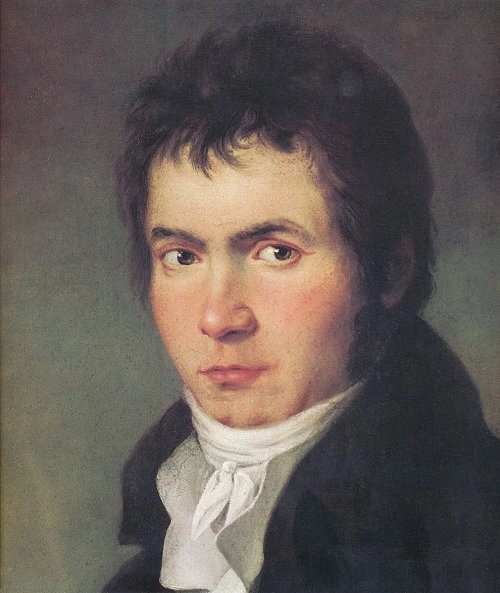
Ludwig van Beethoven (baptised 17 December 1770 – 26 March 1827) was a German composer and pianist. One of the most revered figures in the history of Western music, his works rank among the most performed of the classical music repertoire and span the transition from the Classical period to the Romantic era.
Born in Bonn, Beethoven displayed his musical talent at a young age. He was initially taught intensively by his father, and later by Christian Gottlob Neefe. Under Neefe’s tutelage in 1783, he published his first work, a set of keyboard variations. At age 21, he moved to Vienna, which subsequently became his base, and studied composition with Haydn. Beethoven then gained a reputation as a virtuoso pianist, and was soon patronised by Karl Alois, Prince Lichnowsky for compositions, which resulted in his three Opus 1 piano trios (the earliest works to which he accorded an opus number) in 1795. Around 1798, Beethoven began experiencing symptoms of hearing loss. His days as a virtuoso were numbered. Beethoven’s first major orchestral work, the First Symphony, premiered in 1800, and his first set of string quartets was published in 1801. despite his advancing deafness during this period, he continued to conduct, premiering his Third and Fifth Symphonies in 1804 and 1808, respectively. The year 1804 was to see the completion of the Third Symphony, regarded by most biographers as a landmark in Beethoven’s development. His Violin Concerto appeared in 1806. His last piano concerto (No. 5, Op. 73, known as the ‘Emperor’), dedicated to his frequent patron Archduke Rudolf of Austria, premiered in 1811. By 1815, Beethoven was nearly totally deaf and had ceased performing and seldom appeared in public.After 1810, Beethoven composed many of his most admired works, including his last three symphonies, mature chamber music and the late piano sonatas. His only opera, Fidelio, first performed in 1805, was extensively revised to its final version in 1814.
it was not until about 1819 that his deafness became total, making necessary the use of those conversation books in which friends wrote down their questions while he replied orally, his playing degenerated as he became able to hear less and less. He continued to appear in public from time to time, but most of his energies were absorbed in composing. He would spend the months from May to October in one or another of the little villages near Vienna. Many of his musical ideas came to him on long country walks and were noted in sketchbooks.
He composed the Missa Solemnis between 1819 and 1823 and his final Symphony, No. 9, the first major example of a choral symphony, between 1822 and 1824. His late string quartets, including the Grosse Fuge, of 1825–1826 are among his final achievements.
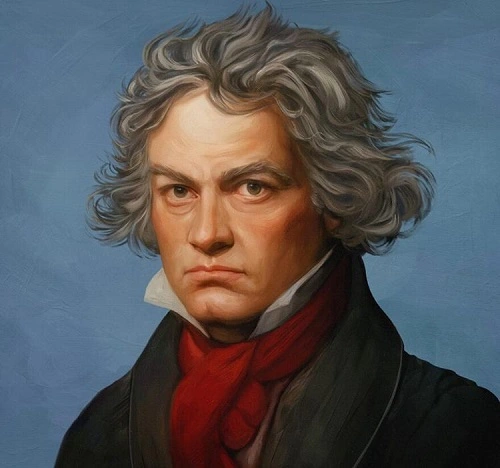
Beethoven’s early period, during which he forged his craft, is typically considered to have lasted until 1802. From 1802 to around 1812, his middle period showed an individual development from the styles of Joseph Haydn and Wolfgang Amadeus Mozart, and is sometimes characterised as heroic. During this time, Beethoven began to grow increasingly deaf. In his late period, from 1812 to 1827, he extended his innovations in musical form and expression.
The works written between 1815 and 1827 comprise a mere fraction of his output after 1792; but they have a density of musical thought far surpassing anything that he had composed before.
After several months of illness, which left him bedridden, Beethoven died on 26 March 1827 at the age of 56. He revealed more vividly than any of his predecessors the power of music to convey a philosophy of life. Though not himself a Romantic, he became the fountainhead of much that characterized the work of the Romantics who followed him. Illustrative music defined by himself in connection with his Sixth (Pastoral) Symphony as “more an expression of emotion than painting.” In musical form he was a considerable innovator, widening the scope Of Sonata , Symphony , concerto, and quartet, expanding their emotional and structural complexity. while in the Ninth Symphony he combined the worlds of vocal and instrumental music in a manner never before attempted.
Sound quality is important and the better online Streaming services will offer superior sound quality. As always, We do encourage you to purchase Favoured albums from good online or High street record stores.
Artists in upcoming issues: Mozart, Brahms and Chopin.......Keep Listening!! JOIN THE CONVERSATION...
“Comments are most welcome and appreciated”