
Classical Music – issue #5
Classical music generally refers to the art music of the Western world. Classical music is often characterized by formality and complexity in its musical form and harmonic organization. particularly with the use of polyphony, music in which several different tunes are played or sung at the same time. Since the ninth century, it has been primarily a written tradition, spawning a sophisticated notational system.
Rooted in the patronage of churches and royal courts in Europe. early medieval music is chiefly religious, monophonic and vocal. The Baroque period (1580–1750) saw the relative standardization of common-practice tonality. Together with, the increasing importance of musical instruments, which grew into ensembles of considerable size. The common-practice period was a period in which the tonal system was regarded as the only basis for composition. The word tonality is sometimes used as a synonym for “key.”.
In the shorter but pivotal Classical period (1730–1820), composers such as Mozart created widely admired examples of absolute music. including symphonies, string quartets and concertos. Absolute music (sometimes abstract music) is instrumental music not intended to represent or illustrate something else. The ensuing Romantic music (1800–1910) focused instead on programmatic music. the art song, symphonic poem and various piano genres were important vessels. Program music is often written so that the notes themselves convey, to some degree, the meaning of what is portrayed. Thus the thunderstorm in Beethoven’s symphony includes loud timpani strokes to convey the thunder. The shrill piccolo music to depict the shrieking winds. During this time virtuosity was celebrated, immensity was encouraged, while philosophy and nationalism were embedded. all aspects that converged in the operas of Richard Wagner.
By the 20th century, the prominence of popular music greatly increased. Many Classical composers actively avoided past techniques and genres in the lens of modernism. with some abandoning tonality in place of serialism. a serial pattern in music is merely one that repeats over and over within a composition. The term serial music is often used interchangeably with 12-tone music. However, the latter is more properly an example of the former. others found new inspiration in folk melodies or impressionist sentiments.
Trends of the mid-20th century to the present day include New Simplicity, New Complexity, Minimalism, Spectral music. more recently Postmodern music and Postminimalism.
Join the Conversation!!!
we will Feature Significant Compositions from Artists representative of the various classical Periods. We Hope to encourage Listeners of all tastes and passions. So Get your Headphones on and Consider discussing the musical Offering and sharing your views with like-minded peers.
In Issue #5, we feature Frédéric Chopin
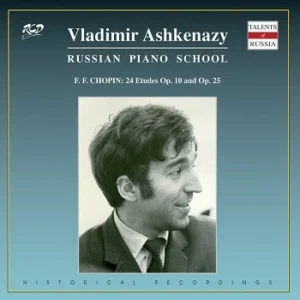
Chopin’s two books of Etudes, or studies, stretch a player’s advanced technique. But the music contains depth and feeling. Études Op. 10 is a set of 12 solo piano pieces composed between 1829 and 1832. Études, Op. 25, published in 1837, is a set of 12 solo piano works widely considered the pinnacle of 19th-century technical and musical innovation. Highlights Include: the passionate, powerful Op. 10, No. 12, ‘Revolutionary’. Written in 1831 upon hearing that the Russian army had crushed Poland’s November Uprising. this etude is a work of pure kinetic fury and patriotic desperation. Op. 10, No. 3 “Tristesse”: Renowned for its beautiful, melancholic melody. Op. 10, No. 5 “Black Key”: Known for its light, rapid, and playful style.
Op. 25, No. 11 “Winter Wind”: A technically challenging, sweeping work. Op. 25, No. 12 “Ocean”: The nickname “Ocean” arises from these sweeping arpeggios, which evoke the sound of crashing waves and a powerful storm.
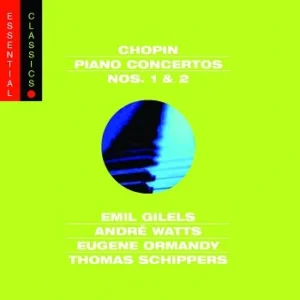
Piano Concerto No. 1 in E minor Three movements – Allegro maestoso: Known for its long orchestral introduction and brilliant piano entrance.
Romance – Larghetto: Described by Chopin as a “moonlight reverie on a beautiful spring night”.Rondo – Vivace: A vivacious finale incorporating the Krakowiak, a traditional Polish folk dance. Piano Concerto No. 2 in F minor, Op. 21, is a landmark of Romantic piano literature, composed in 1829 when the composer was only 19 years old. Despite its numbering, it was actually written before Piano Concerto No.1 but published later in 1836. iod.
Fantaisie-Impromptu, Op. 66. this impromptu combines rapid, cascading passages with a lyrical, song-like middle section.
Scherzo No. 2 in B-flat minor, Op. 31. Dramatic and fiery, this scherzo opens with mysterious descending chords before bursting into a whirlwind of energy.
Polonaise in A flat major, ‘Heroic’ a powerful and patriotic piece. Its bold, majestic themes and triumphant rhythms embodying both strength and grace. Piano Sonata No. 2 in B flat minor, ‘Funeral March’. best known for the iconic slow movement. However, the two outer movements feature music that is by turns effervescent and mysterious.
Nocturne in E flat major, op. 9 no. 2 characterized by its gentle, flowing melody and tranquil beauty. a Quintissentioal Romantic piano work. Ballade No. 1 in G minor. The work combines a dramatic narrative structure with intense emotional gear changes and soaring, lyrical melodies. .
Prelude in D-flat Major, Op. 28 No. 15 ‘Raindrop’ Evocative and atmospheric, with gentle repetition that swells into powerful emotion. built around a repeated note that evokes falling rain. both accessible and emotionally profound.
Etudes Opus 10 and opus 25 – selections
Piano Concertos nos 1 & 2
Other Works – selections
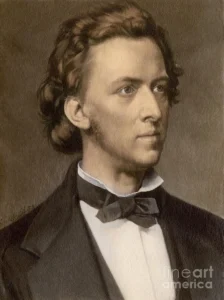
Frédéric François Chopin (1 March 1810 – 17 October 1849) was a Polish composer and virtuoso pianist of the Romantic period who wrote primarily for solo piano. He has maintained worldwide renown as a leading composer of his era whose “poetic genius was based on a professional technique that was without equal in his generation” according to the American pianist and music critic Charles Rosen.
Chopin was born in Żelazowa Wola and grew up in Warsaw, which in 1815 became part of Congress Poland. A child prodigy, by the age of seven he had begun giving public concerts, and in 1817, he composed two polonaises, in G minor and B♭ major. Despite the lively musical life of Warsaw, Chopin urgently needed wider musical experience, and so his devoted parents found the money to send him off to Vienna. After a preliminary expedition to Berlin in 1828, Chopin visited Vienna and made his performance debut there in 1829. A second concert confirmed his success, and on his return home he prepared himself for further achievements abroad by writing his Piano Concerto No. 2 in F Minor (1829) and his Piano Concerto No. 1 in E Minor (1830), as well as other works for piano and orchestra. He left Warsaw on 2 November 1830, with the intention of visiting Germany and Italy for further study. He had gone no farther than Vienna when news reached him of the Polish revolt against Russian rule. He settled in Paris. Chopin settled down to the main business of his life—teaching and composing. His high income from these sources set him free from the strain of concert giving. Chopin formed a friendship with Franz Liszt and was admired by many musical contemporaries, including Robert Schumann. Chopin found himself a favourite in the great houses of Paris, both as a recitalist and as a teacher. His new piano works at this time included two startlingly poetic books of études (1829–36), the Ballade in G Minor (1831–35), the Fantaisie-Impromptu (1835), and many smaller pieces, among them mazurkas and polonaises inspired by Chopin’s strong nationalist feeling. In 1836 he met for the first time the free-living novelist Aurore Dudevant, better known as George Sand; their liaison began in the summer of 1838.
That autumn he set off with her and her children, Maurice and Solange, to winter on the island of Majorca. they rented a simple villa until the sunny weather broke and Chopin became ill. The summer of 1839 they spent at Nohant, Sand’s country house south of Paris. The long summers spent at Nohant bore fruit in a succession of masterpieces. For a regular source of income, he again turned to private teaching and with a growing demand for his new works he could afford to live elegantly. Chopin produced much of his most-searching music at Nohant, not only miniatures but also extended works. he found the peace and time to indulge an ingrained quest for perfection. in this period he also grew much more daring, though never at the cost of sensuous beauty. Family dissension arising from the marriage of Sand’s daughter, Solange, caused Chopin’s own relationship with Sand to become strained, and, by 1848 the rift between him and Sand was complete. Pride prevented either from effecting the reconciliation they both actually desired. Thereafter Chopin seems to have given up his struggle with ill health. Broken in spirit and depressed by the revolution that had broken out in Paris in February 1848, Chopin accepted an invitation to visit England and Scotland. His reception in London was enthusiastic. He made his last public appearance on a concert platform at the Guildhall in London on November 16, 1848. He returned to Paris, where he died the following year; his body, without the heart, was buried at the cemetery of Père-Lachaise (his heart was interred at the Church of the Holy Cross in Warsaw).
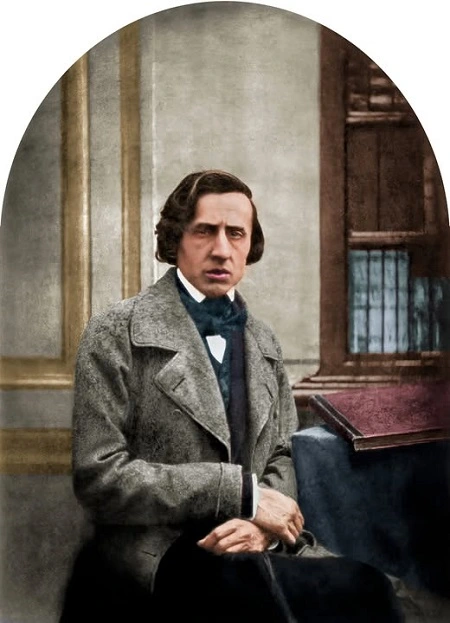
His music, delicate yet emotionally overwhelming, spoke a new language — one of intimate poetry, inner turmoil, and lyrical grace. Every nocturne, prelude, and étude seems to breathe with the pulse of the man himself: fragile in health, fiercely private, yet capable of revealing profound truths through the keyboard. A Romantic in the deepest sense, Chopin lived a life shaped by exile, ill health, and doomed love. Yet he transformed personal suffering into art of transcendent beauty..
Chopin was no easy character. He was fragile, fussy and precious; he was oversensitive about his large nose; and he had a nasty streak of anti-Semitism. But let Chopin sit down at a piano and he was in his element. Chopin’s best loved works include the Polonaises. the four passionate and stormy Ballades, the Piano Concerto No. 1, and the Mazurkas, in which the composer delivers his own typically dramatic and captivating interpretations of a traditional Polish dance.Then there are the dreamy, twilit Nocturnes – relatively simple pieces compared to some of Chopin’s other compositions, with the left hand usually providing a steady rhythmic accompaniment to the songful, lyrical lines played by the right hand.
Sound quality is important and the better online Streaming services will offer superior sound quality. As always, We do encourage you to purchase Favoured albums from good online or High street record stores.
Artists in upcoming issues: Stravinsky, shostakovich, Richard strauss, Mozart, Brahms and Liszt......Keep Listening!! JOIN THE CONVERSATION...
“Comments are most welcome and appreciated”