jazz Music – issue #1
Jazz is a music genre that originated in the African-American communities of New Orleans. Since the 1920s Jazz Age, it has been a major form of musical expression in traditional and popular music. It was developed partially from ragtime and blues. often characterized by syncopated rhythms and polyphonic ensemble playing. incorporating varying degrees of improvisation, often deliberate deviations of pitch, and the use of original timbres. As jazz spread around the world, it drew indigenous musical cultures, which gave rise to different styles. In the 1930s, arranged dance-oriented swing big bands was the prominent styles. Bebop emerged in the 1940s, representing a shift from danceable popular music. Now a more challenging music emerged which was played at faster tempos and used more chord-based improvisation. Cool jazz developed near the end of the 1940s, introducing calmer, smoother sounds and long, linear melodic lines. Free jazz is a style of avant-garde jazz . This experimental style of jazz improvisation developed in the late 1950s and early 1960s. Jazz fusion appeared in the late 1960s and early 1970s. a Fusion combining jazz improvisation with rock music’s rhythms, electric instruments, and highly amplified stage sound. In the early 1980s, a commercial form of jazz fusion called smooth jazz became successful, garnering significant radio airplay. For almost all of its history it has employed both creative approaches in varying degrees and endless permutations. despite the all these diverse styles, jazz is distinguishable as something separate from all other forms of musical expression. Especially from classical music. The jazz performer is primarily or wholly a creative, improvising composer. On the other hand in classical music the performer typically expresses and interprets someone else’s composition.
Join the Conversation!!!
we will Feature Up to 3 Albums from Artists representative of a range of the Many sub-genres. We Hope to encourage Listeners of all tastes and passions. So Get your Headphones on and Consider discussing the musical Offering and sharing your views with like-minded peers.
In Issue #1, we feature Miles Davis
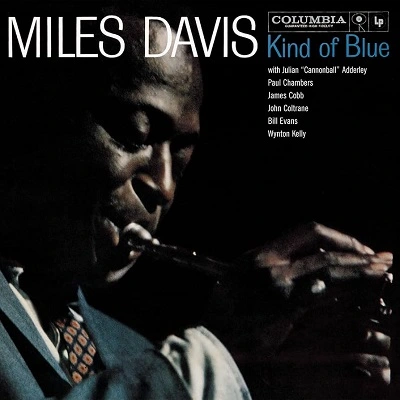
Kind of Blue is the landmark 1959 Studio Album, widely considered his masterpiece and the best-selling jazz album of all time. The album is famous for pioneering modal jazz, where improvisation is based on musical scales (modes) rather than complex chord changes, giving the musicians more creative freedom. created with minimal direction from Davis to the musicians, resulting in highly spontaneous performances. the all-star sextet Miles had assembled to accompany him, including three players (John Coltrane, Bill Evans, Cannonball Adderley) who would themselves prove to be jazz legends, and a rhythm section (Wynton Kelly, Paul Chambers, Jimmy Cobb) that “outswung” any other in its day.
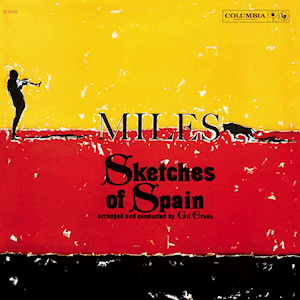
Sketches of Spain is a critically acclaimed 1960 Studio Album. The album is a masterpiece of the “Third Stream” genre a tag applied to music that Synthesises Classical Music and Jazz. In this case, fusing jazz, European classical, and traditional Spanish folk music styles. The centerpiece of the album is an adaptation of the slow movement (Adagio) from Joaquín Rodrigo’s classical guitar piece, Concierto de Aranjuez. The album pairs Davis with arranger and composer Gil Evans. Evans’ arrangements are highly regarded for their rich, detailed orchestration. Replying to suggestions that Sketches of Spain was something other than jazz, Davis said “it’s music, and I like it.”
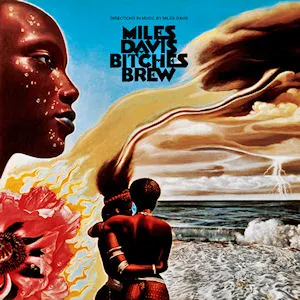
Bitches Brew is a highly influential and controversial Jazz Fusion Double Album, released on March 30, 1970. It is a landmark work that essentially defined the jazz-rock genre, blending jazz improvisation electric instruments like electric piano, guitar, and bass, alongside multiple drummers and percussionists. It was heavily influenced by contemporary rock acts like Jimi Hendrix and funk artists like Sly and the Family Stone. initially received with a mixed critical response, with many traditional jazz purists labelling it “anti-jazz.” The surreal, Afro-futurist album cover by the German artist Mati Klarwein, played right into the sensibilities of stoned-out psychedelic rock fans. Inspired by that image, Carlos Santana used a different one by the same artist for his smash album Abraxas.
kind of Blue
sketches of Spain
bitches Brew
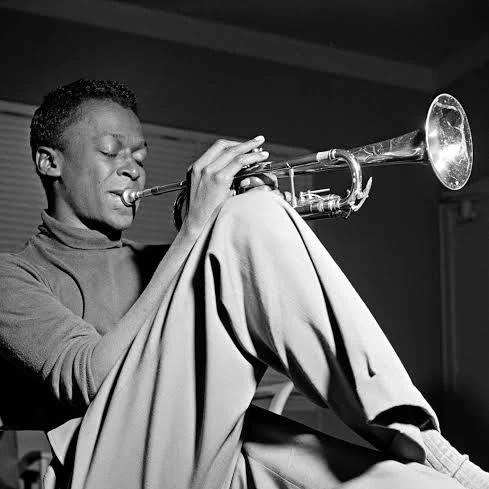
Born into an upper-middle-class family in Alton, Illinois, and raised in East St. Louis, Davis started on the trumpet in his early teens. He left to study at Juilliard in New York City, before dropping out and making his professional debut as a member of saxophonist Charlie Parker’s bebop quintet from 1944 to 1948. In the early 1950s, while addicted to heroin, he recorded the Birth of the Cool sessions for Capitol Records. They were to be instrumental to the development of cool jazz. He signed a long-term contract with Columbia Records, and recorded the album ‘Round About Midnight in 1955. It was his first work with saxophonist John Coltrane and bassist Paul Chambers, key members of the sextet he led into the early 1960s. During this period, he alternated between orchestral jazz collaborations with arranger Gil Evans, such as the Spanish music–influenced Sketches of Spain (1960), and band recordings, such as Milestones (1958) and Kind of Blue (1959). The latter recording remains one of the most popular jazz albums of all time. After adding saxophonist Wayne Shorter to his new quintet in 1964, Davis led them on a series of more abstract recordings often composed by the band members, helping pioneer the post-bop genre.
Later, transitioning into his electric period. During the 1970s, he experimented with rock, funk, African rhythms, emerging electronic music technology, and an ever-changing line-up of musicians. His million-selling 1970 record Bitches Brew helped spark a resurgence in the genre’s commercial popularity with jazz fusion as the decade progressed. Columbia released live albums including recordings of two sets from February 1, 1975, in Osaka, by which time Davis was troubled by several physical ailments; he relied on alcohol, codeine and morphine to get through the engagements. His shows were routinely panned by critics who mentioned his habit of performing with his back to the audience. After appearances at the 1975 Newport Jazz Festival in July and the Schaefer Music Festival in New York in September, Davis dropped out of music. Miles Davis’s hiatus from the music scene was marked by a Combination of illness, exhaustion, and creative burnout. This period lasted for five years, during which he stopped touring and shunned the Recording Studio. It wasn’t until 1985 that he recorded a new album and returned to live performance. Davis began to collaborate with a number of figures from the British post-punk and new wave movements during this 80’s period. This period also saw Davis move from his funk inspired sound of the early 1970s to a more melodic style. His post-Retirement Period Was Marked by a Period of Intense Creativity, During Which He Recorded nine studio albums and made Numerous Guest recordings. Despite the hiatus, Davis’s influence on jazz and music remains profound, and his final decade is often regarded as one of his most productive. From then to 1991, Davis remained vital and popular, receiving the Grammy Lifetime Achievement Award in 1990. In early September 1991, Davis checked into Hospital near his home in Santa Monica, California, in hospital he suffered a stroke followed by a coma. After several days on life support, his machine was turned off and he died on September 28, 1991. He was 65 years old.
Sound quality is important and the better online Streaming services will offer superior sound quality. As always, We do encourage you to purchase Favoured albums from good online or High street record stores.
Artists in upcoming issues: John Coltrane, Bill Evans, brad Mehldau.....Keep Listening!! JOIN THE CONVERSATION...
“Comments are most welcome and appreciated”